
Aktuelles ·
ICAROS: REVOLUTIONARY TRAINING FOR THE DEEP STABILISATION SYSTEM
ADDITIONAL THERAPIES AT ADELI are highly beneficial for both inpatients and accompanying persons. Among the particularly interesting additional therapies at the ADELI Medical Center are exercises on the ICAROS devices. These innovative therapeutic devices combine movement with gaming, strengthening both the body and the ability to concentrate.
Core, body centre, or deep stabilisation system (DSS) – all these terms are synonyms for a fascinating group of around thirty muscles in the human trunk. This complex system ensures the stability of the spine and pelvis, better function of the diaphragm, and the entire musculoskeletal system. The system works continuously and subconsciously.
When the DSS functions properly, load during movement is distributed optimally so that muscles and joints are not overloaded. The body moves in a coordinated and fluid manner, breathing is deep and calm, and there is no cause for pain or injury. However, if the deep stabilisation system is weakened, lower back pain occurs, breathing becomes shallower, and overall performance decreases. In addition, stability and balance deteriorate, increasing the risk of falls and further secondary injuries.
Caring for the core (DSS) therefore deserves special attention. Moreover, a strong core is a sign of self-care.
In the following article, created in collaboration with ADELI Medical Center physiotherapist Mag. Richard Riedl, you will learn more about the deep stabilisation system and ways to relieve acute complaints and prevent chronic conditions, including spinal damage, by strengthening it. Many processes in our body depend on the health of the deep stabilisation system – the health benefits of a strong core are countless.
The deep stabilisation system is the pillar of our balance – physically and mentally
The deep stabilisation system includes the diaphragm, the pelvic floor muscles, the deep abdominal muscles, and the deep back muscles. A key role in stabilising the spine, proper breathing, and trunk movement is also played by the serratus posterior inferior muscle, the costovertebral fibres (rib-vertebra fibres of the quadratus lumborum muscle), and the iliovertebral fibres (pelvis-vertebra fibres of the quadratus lumborum muscle).
A particular focus is placed on the term “diaphragm”. Drawing on his extensive experience as a fitness trainer, Mag. Richard Riedl explains: “Hardly anyone uses the diaphragm to its full potential; often it is barely engaged at all. Put simply: ‘We do not know how to breathe properly.’” Yet the diaphragm plays a crucial role in respiration – it acts like a piston. Inactivity of the diaphragm can cause numerous pathological conditions, alongside an unstable spine and insufficient oxygen supply to the body. The foundation of any movement should therefore be learning a correct breathing pattern, the so-called breathing wave. “Personally, I advocate teaching proper breathing techniques as early as possible – as soon as a child is cognitively able to grasp this information. If an incorrect breathing pattern is used over a long period, it becomes difficult to relearn the correct one. Of course, an incorrect breathing pattern can also be acquired later in life through various illnesses or chronic stress. PROPER BREATHING IS THE FOUNDATION!” explains Richard Riedl.
The respiratory muscles – especially the diaphragm – play a key role in core activation. Conscious breathing training is therefore one of the essential elements of any meaningful stabilisation technique. Yet this excursion into proper breathing also demonstrates how closely different processes in our body are intertwined, and how a disruption in one system can cause problems in an entirely different area.
Only when the foundation of breathing is laid can targeted DSS training unfold its full effect. Strengthening the deep stabilisation system through targeted therapeutic approaches delivers:
Prevention of back pain: The deep musculature is activated, relieving the spine and reducing strain on the lumbar region.
Improved posture: A strong core supports correct body posture and helps prevent a rounded back.
Increased stability and balance: Training the core muscles significantly reduces the risk of falls, especially in older adults and individuals recovering from injuries.
Support for functional movements: Everyday activities such as walking, running, or lifting become more efficient and place less strain on the musculoskeletal system.
Enhanced athletic performance: A strengthened core translates into increased explosiveness, endurance, and coordination.
Improved breathing and internal stability: Activating the deep stabilisation system leads to noticeably better respiration and optimal regulation of intra-abdominal pressure.
How can you strengthen the deep stabilisation system?
For the past two decades, two popular exercises for the deep stabilisation system have been widely used: the classic plank and the side plank. Yet both exercises have a catch: “No one can hold the plank position for more than 2 to 3 minutes, especially when I, as a long-time trainer and physiotherapist, ensure that posture remains absolutely correct. And I certainly cannot imagine individuals with various muscular or neurological conditions holding this position for any length of time!” explains Mag. Richard Riedl.
This is where a major innovation comes into play: the ICAROS Health device. It mobilises the deep stabilisation system on an entirely new foundation, making training significantly more effective!
What is ICAROS Health?
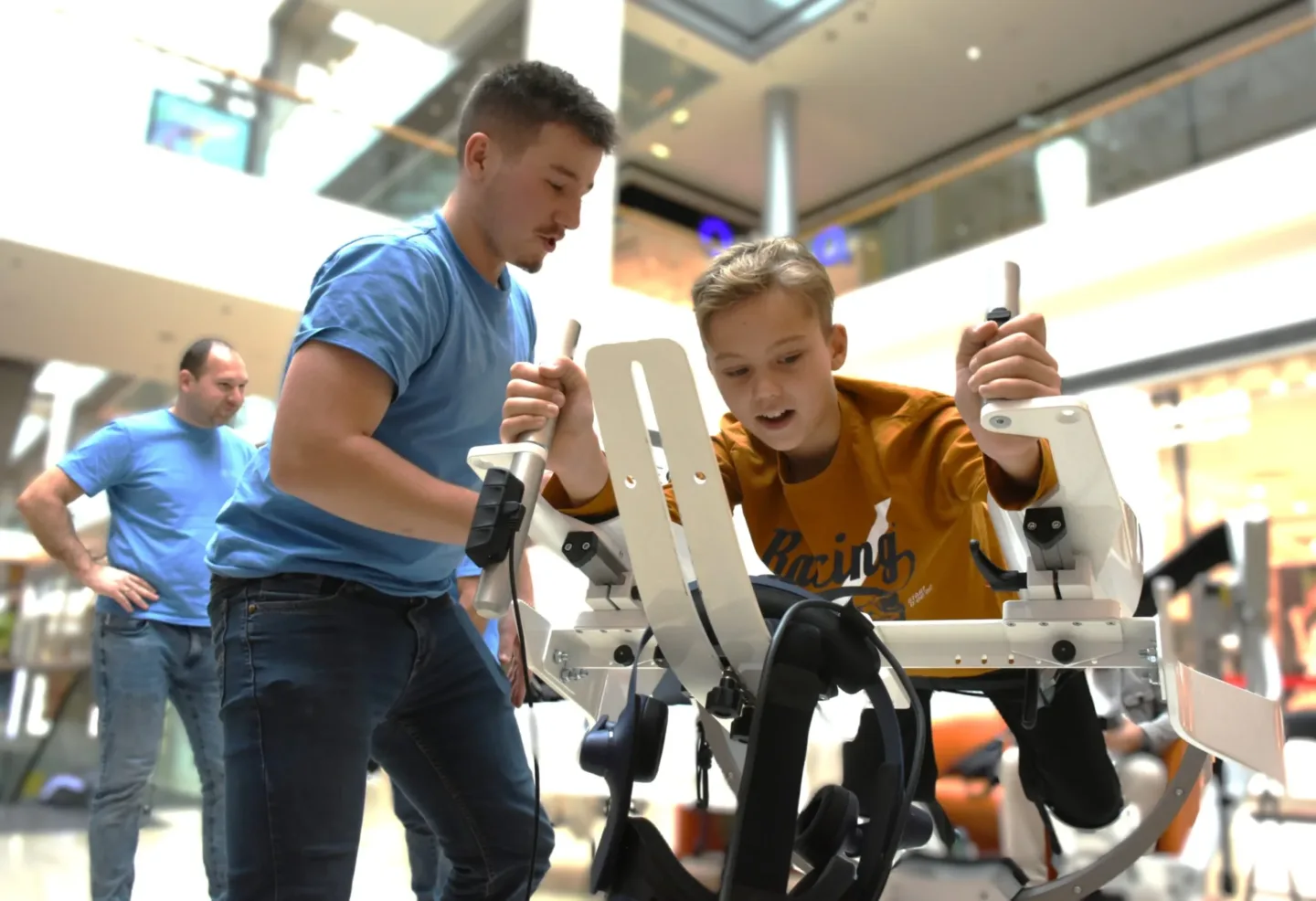
ICAROS Health is an ergonomically designed device featuring a lightweight yet robust metal frame. It allows the user to lie horizontally on their stomach, facing forward. Adjustable arm and foot supports provide comfortable, secure support throughout the workout. Tilting the body to the left, right, forward, and backward is made possible by the central pivot axis. The device is controlled by the user through their own initiated movements, with movement remaining smooth and controlled thanks to mechanical or pneumatic dampers.
Body movements control the “flight”, which is displayed both on the screen and inside the 3D virtual reality headset. Adjustable resistance allows the intensity of the workout to be tailored to individual needs. Integrated sensors and electronics ensure seamless interaction with the virtual environment. Virtual reality is displayed through the 3D headset. The stereoscopic display provides depth perception and a 360-degree environment, creating an experience of complete immersion in the simulated virtual world. Accelerometers and gyroscopes track the user’s movements, and the collected data is transmitted directly into the virtual reality system. ICAROS is also compatible with smart devices, allowing performance tracking and detailed analysis of training results.
What are the benefits of ICAROS Health?
The core functions of ICAROS Health include balance training to enhance stability and motor coordination, as well as strengthening the deep musculature – including the core, back, shoulders, and legs. Training on the ICAROS yields particularly impressive results in neurological and orthopaedic rehabilitation. Furthermore, ICAROS has a powerful motivating effect: virtual reality allows the user to navigate simulated environments such as flying, deep-sea diving, or sports games.
ICAROS Health is used in rehabilitation centres, hospitals, sports clubs, and wellness facilities. Thanks to the combination of physical movement and virtual reality, it offers an entertaining, motivating, and highly effective workout.
“ICAROS Health features adjustable segments that support correct posture according to individual needs. When training is combined with an immersive virtual reality experience, a 30-minute workout in the ‘plank’ position becomes genuinely achievable,” says physiotherapist Richard Riedl regarding the tremendous difference between traditional training methods and ICAROS Health.
“This brings us to why training on the ICAROS is so effective: when movement is coupled with free flight or diving, we engage profound sensory impressions that activate our brain centres much more intensely. A positive training experience serves as a powerful motivator for patients, fostering the determination to continue therapy,” notes Richard Riedl, highlighting the rewarding point collection and the challenge of competing against oneself (or joining online competitions with other users).
Use of ICAROS at ADELI Medical Center
ADELI Medical Center specialises in rehabilitating neurological patients. ICAROS Health helps activate the central nervous system while specifically strengthening the deep stabilisation system.
Richard Riedl highlights: “The more frequently a movement is performed, the more stable the positive changes become. And that is precisely what ICAROS is all about.”
Conclusion
ICAROS Health represents the ideal combination of fun and effective training, strengthening not only the core muscles but also supporting rehabilitation and the overall health of the musculoskeletal system. Its integration into therapy brings patients not only physical benefits, but also psychological well-being and renewed motivation for an active lifestyle.
The indications for ICAROS Health are diverse, ranging from neurological conditions and functional musculoskeletal disorders to competitive sports.
In addition to its primary function – strengthening the deep stabilisation system – ICAROS Health is designed for orthopaedic patients suffering from lumbar spine pain, patients recovering from a stroke, and, in selected cases, individuals with cerebral palsy. Thanks to its smooth adjustability, ICAROS Health can be easily tailored to the individual needs of each patient.