
Aktuelles ·
Children with SMA Train Their Muscles at the ADELI Center After Receiving Zolgensma
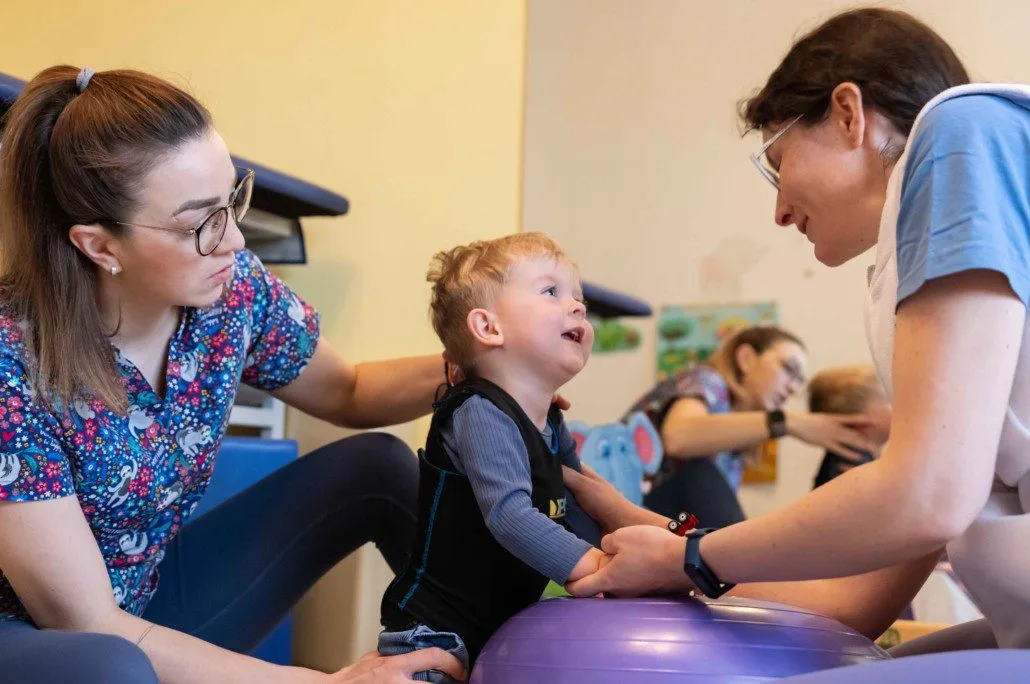
In this article by reporter Ján Krempaský from the newspaper SME, we present five stories of children with spinal muscular atrophy who are undergoing rehabilitation to build up their muscles at the ADELI Medical Center (a rehabilitation clinic based in Piešťany, Slovakia).
THE CHILDREN SUFFERED FROM SPINAL MUSCULAR ATROPHY; AN EXPENSIVE MEDICATION HELPED THEM.
They were like rag dolls. Some of them could not even lift their arms; others lay motionless in bed. Their condition resembled that of two-year-old Editka Rischerová from Western Slovakia, who, like them, suffers from spinal muscular atrophy (SMA). This is an inherited neuromuscular disease that affects the part of the nervous system controlling muscle movement. However, it does not affect the child’s cognitive abilities. People affected by this disease are intelligent and alert. If it is possible to halt or reverse the progression of the disease, they are also manually dexterous. Due to the condition, however, affected children gradually lose the ability to sit, walk, and stand. Breathing and swallowing difficulties also frequently arise. When Editka received the medication worth two million euros—Zolgensma—which is able to halt the progression of this disease, in March of this year, a controversy arose in Slovakia over whether the girl should receive it. It costs two million euros and is not covered by public health insurance. Yet Editka is not the only child to have received this medication. The SME newspaper spoke with five parents from Slovakia, the Czech Republic, Austria, and Germany whose children have SMA and have received Zolgensma. All of them undergo rehabilitation at the ADELI Medical Center in Piešťany. Editka's parents had not responded by the deadline to the question of how their daughter is doing after receiving Zolgensma. They are currently preparing an appeal to the Constitutional Court regarding the decision of the regional court in Bratislava.
The regional court overturned the initial district court decision that had ordered the General Health Insurance Company (VšZP) through an interim injunction to pay for Editka's medication.
A LITTLE FIGHTER FROM OSTRAVA
“My wife cries with every bit of progress the little boy makes. Those are tears of joy,” says Tomáš Fiala from Ostrava about the improvement in the health of his three-and-a-half-year-old son Tomáš after the administration of Zolgensma and rehabilitation at the ADELI Center. “In the beginning, we had a child who could only lie flat,” recalls little Tomáš’s father. The boy was born at the end of 2019. Until his tenth month, he was completely healthy. Then Tomáš’s wife took their son for a routine check-up, where she told the doctor that he could not roll over onto his stomach and could not sit up on his own. He also had trouble swallowing large pieces of food. After several examinations, little Tomáš was diagnosed with spinal muscular atrophy in December 2020. He has type 2, like Editka. Much like her parents, Tomáš’s parents initially faced challenges getting approval for Zolgensma, which in the Czech Republic is also covered only by exceptional approval. “We were insured with a smaller regional health fund,” explains Tomáš’s father. According to him, the insurer struggled to cover both Zolgensma and Spinraza for the boy. However, the Slovak VšZP immediately approved the second medication for Editka. Spinraza is not as effective as Zolgensma, though, and must be administered for life. With Zolgensma, a single dose is sufficient. Despite the initial hurdles, little Tomáš received Zolgensma in the second half of March 2021. At that time, he was one year and three months old. After the administration of the two-million-euro drug, his condition improved considerably. “The first progress was crawling,” recalls the boy’s father. “Six months later came sitting. Now he is even starting to stand up. He stands on his own, even without support,” Tomáš Fiala senior beams with joy. The improvement in his condition was also supported by Tomáš’s rehabilitation therapies. When the Fialas first visited ADELI, their son could not climb onto the sofa and get down again. “Now he can do it without any problems,” says the boy's father. However, rehabilitation at ADELI in Piešťany is not an inexpensive undertaking. Marketing consultant Lenka Chovanec notes that a two-week rehabilitation stay costs more than 2,800 euros. The Fialas were able to afford it thanks to a fundraising campaign via a transparent bank account.
“FROM A RAG DOLL TO A VIBRANT LITTLE GIRL”
“My daughter was practically a bedridden, motionless rag doll. She could lift her arm, but only from the elbow,” recalls Marcela, the mother of Amélie Bartakovics from Horné Saliby near Galanta. Amélie is one of four children—alongside Alex, Alexej, and Richard—for whom all of Slovakia raised funds for Zolgensma four years ago. Even the Speaker of Parliament Boris Kollár (Sme rodina) promised financial help. Thanks to transparent accounts, the children, including Amélie, were able to raise the money for the drug. “When we asked the health insurance to cover Zolgensma, it had not yet been approved by the European Medicines Agency (EMA),” the girl’s mother recalls. After the EMA registered the drug in May 2020, Amélie received it in June of the same year. She was one and a half years old. Unlike Editka, Amélie has SMA type 1. “Zolgensma helped Amélie primarily with her motor skills,” says her mother. After receiving the medication and undergoing regular rehabilitation sessions, her daughter can now sit in a wheelchair for half an hour and hold her head up for several seconds, according to her mother. She can turn onto her stomach on her own. She has even begun to speak simple words and short sentences. “Her breathing has improved; she can breathe during the day without a ventilator,” says Marcela Bartakovics happily. “All these advances are visible and make our lives so much easier,” she adds. “During rehabilitation, we learned how to position Aminka properly and do exercises with her to strengthen her muscles,” her mother explains. Speech therapy was also a major benefit. “At that time, my daughter was not yet speaking; we were recommended orofacial stimulation and a special speech therapy massage device to strengthen the muscles,” she explains. Today, Amélie speaks in simple sentences. Despite the improvement in her health, however, the girl faces another challenge: scoliosis, a spinal deformity. It is one of the accompanying symptoms of SMA. “It is mainly caused by muscle weakness,” Amélie’s mother explains. “In our case, overheating also played a big role. Aminka must not overheat, and we had to keep her in a position where she wouldn't get too warm,” Marcela Bartakovics explains. The scoliosis therefore also developed due to positioning. For this reason, Amélie’s parents have decided to undergo scoliosis surgery in Hamburg. “In the near future, we have our first preliminary consultation, where we will find out the exact date of the surgery,” says the mother. “Let’s be realistic,” Marcela Bartakovics says. In her view, her daughter would have had a great chance of being a nearly healthy child if she had received Zolgensma immediately after birth, before the first signs of the disease appeared. However, Amélie only received the medication at the age of one and a half, even though she was diagnosed at three months old. “We believe there is very little chance that she will ever be able to walk in the future,” says the realistic mother of the three-year-old girl.
A LITTLE ATHLETE FROM BERLIN
“Yes, we have always believed that he will be able to walk one day,” says Doreen, the mother of two-year-old Lukas Pötter from a small village near Berlin. “He is very strong and fights for every improvement in his health through physiotherapy and exercise,” she adds. When Luke was born in May 2021, he had no health complications, according to his mother. Within two months, however, this changed when he was diagnosed with SMA type 1 in July. According to Doreen, the disease progressed rapidly, which is why she considers it the greatest success that her son is alive at all. By the time he received Zolgensma in August 2021, he could only move his legs, whereas after birth he had been able to lift his legs and arms and hold his head up in the prone position. Fortunately, help in the form of Zolgensma came early. Just one month after being diagnosed with SMA, he received the medication. “We had no out-of-pocket expenses for Zolgensma,” says Doreen. Her son’s health insurance covers nearly one hundred percent of the treatment costs. Luke’s mother says that his condition improved after the drug was administered in August 2021. Suddenly, he was able to move his legs again for a few seconds. “Luke now rolls across the floor in the room,” his mother beams, highlighting the improvement in his condition. Rolling over is a huge milestone for a child with this disease. The boy can even lift both legs to his mouth and pick up lightweight objects with his hands. Rehabilitation at the ADELI Center, where Luke has been once so far, has also contributed to his progress. His mother admits that the start of the stay was not easy. “The initial phases of therapy there are very tough on any mother’s heart,” says Doreen. The physiotherapists interviewed by SME note that children do not always want to perform the prescribed exercises and cry as a result. Some mothers find this difficult. Nevertheless, Doreen acknowledges that the rehabilitation has helped her son tremendously.
LITTLE DRIVER FROM SALZBURG
“Without Zolgensma, my daughter would not be who she is today—a radiantly happy and contented child,” says Danijela Vukmanovič from Lungau in Salzburg about her two-and-a-half-year-old daughter Anastasia. The little girl suffers from SMA type 1. The disease was diagnosed in May 2020, and one month later she became the first child in Austria to receive Zolgensma at a state hospital in Salzburg. The two-million-euro medication was fully funded by the hospital for Anastasia, says her mother Danijela. After receiving Zolgensma, the girl’s health improved significantly. She began to control her head and hands independently. “She can eat with a spoon and fork. She drives her wheelchair by herself and, of course, she also plays and draws,” Danijela shares. Rehabilitation at the center in Piešťany has also contributed to the skills she has acquired. “We have already been there three times and it was wonderful. Anastasia gained so much strength and energy during these stays,” says her mother. She plans to return to the center with her daughter after the surgery for scoliosis, which Anastasia also suffers from. The procedure will be performed at the University Hospital Graz.
MEDICATION ON DAY 18
Of all the children mentioned in this article, Emil from Germany was the first to receive Zolgensma. That is not his real name. “We would like to let him decide for himself one day whether his medical diagnosis should be made public,” explains his mother Marina. This is not her real name either. However, SME knows the true identities of both. Emil received Zolgensma as early as the 18th day after birth. He was diagnosed with SMA type 1 on day 13. Health insurance reimbursed the medication without any issues. The boy showed symptoms of the disease immediately after birth. “He had so little muscle tone in his body that his arms just dangled down when you carried him. He also couldn't clasp his fingers tightly like other newborns,” Marina describes Emil’s condition. After the administration of Zolgensma, a visible improvement occurred after just two months. He was suddenly able to bring his arms together, which had previously hung limp at his sides. Rehabilitation at the center in Piešťany has also visibly helped him. These stays were covered by health insurance as well. In Slovakia or the Czech Republic, parents have to pay for such rehabilitation stays almost entirely out of pocket. According to his mother, the rehabilitation helps Emil particularly with stabilizing his trunk, which is essential for walking. Marina is convinced that even if her son needs a walking stick or wheelchair for longer distances, the most important thing is that he stays active.
“Yes, I hope that our son will walk normally. Even if it happens later and more slowly,” Marina says, holding onto hope.
Ján Krempaský © SME, Published in June 2023