
Aktuelles ·
A spinal cord infarction is a rare, dangerous condition. Even emergency personnel often find it difficult to recognise
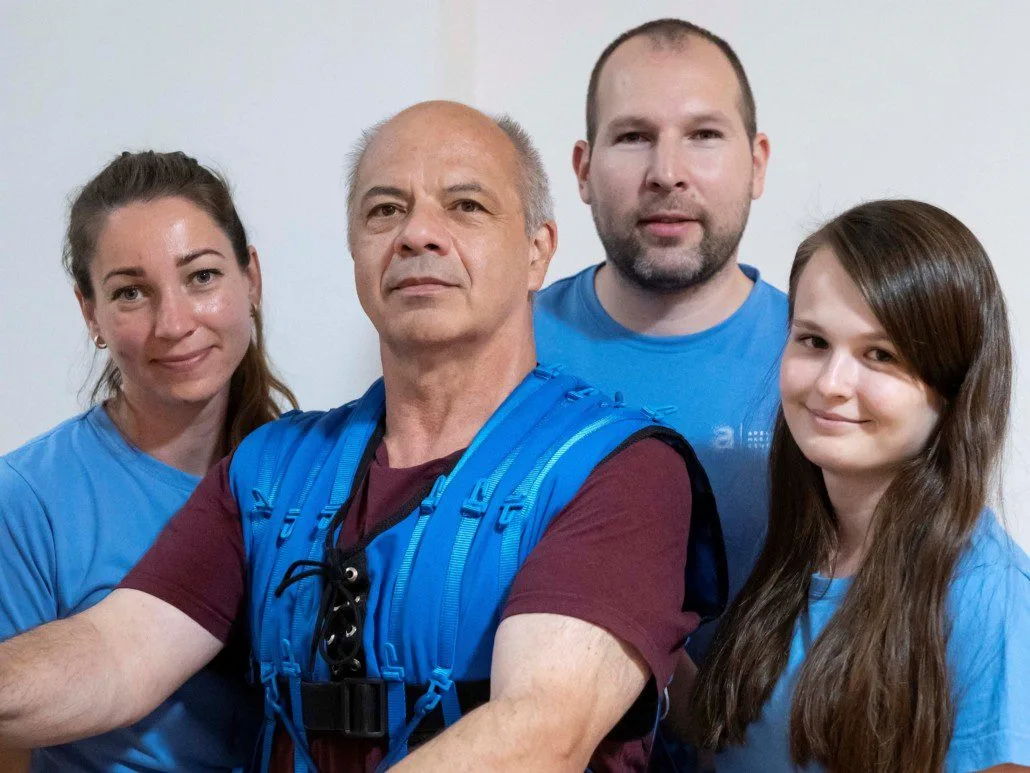
It happened after a holiday. Dusan felt severe pain between his shoulder blades and was unable to move his arms. Beata, Dusan's wife, assessed the situation as a possible heart attack and they rushed to the hospital. While lying in the hospital right before the doctors' eyes, Dusan became paralysed, yet the results regarding his heart were fine… It took considerable effort to have Dusan transferred to the neurology department, where the underlying cause of why a conscious patient was paralysed could be investigated. The MRI scan confirmed the findings in the spinal cord…
Symptoms of a spinal cord infarction include: sudden, severe back pain, immediately followed by very rapidly progressing bilateral flaccid limb paralysis and sensory deficits, particularly regarding pain and temperature. The diagnosis is confirmed using an MRI.
This was how successful entrepreneur Dusan, at the age of 58, learned his verdict: spinal cord infarction. In medical terms: spinal cord ischaemia, myelomalacia, hence spinal cord damage. He was told: “There is nothing that can be done; the condition (paralysis) is irreversible.” “I couldn't believe that the spinal cord could also suffer an infarction. But it happened to me. In that moment, I knew clearly what I did not want. I love freedom and could not accept being bedridden or dependent on help in a wheelchair. I knew I would do something about it, and my athletic spirit kicked in,” Dusan says today.
The blood vessels in the spinal cord are very small and delicate. In the case of a cerebral infarction, the blood has a chance to find an alternative “pathway” and supply all required areas with oxygen. The spinal cord, however, is narrow, and a blockage or rupture of one of the vessels can cause a complete disruption of the blood supply to other areas. As a result, a complete “shut down” of the area can occur, much like a power outage across an entire city.
Statistics show that spinal cord infarctions account for approximately 1% of all cases of circulatory disorders. Doctors rarely encounter this diagnosis, which often makes timely identification difficult. With an infarction, however, the speed of first aid plays a vital role. The longer an area suffers from oxygen deprivation, the more cells die within it.
Following emergency medical care, the elimination of the causes (where possible), medication, or surgical restoration and maximum improvement of blood circulation in the affected area, a recovery phase begins. During this recovery, carefully selected, high-quality, and sufficiently intensive rehabilitation plays the most crucial role. It must be cautious and exceptionally professional to prevent a recurrent infarction.
Dusan completed his very first rehabilitation abroad and has since remained loyal to the Slovak ADELI Medical Center.
Despite the rarity of this diagnosis, we encounter it frequently at ADELI Medical Center. The programmes at ADELI Medical Center in Piešťany are tailored taking into account the specific characteristics of each individual patient, their age, associated diagnoses, baseline condition, and even their biological rhythms of activity and rest throughout the day. These aspects are evaluated by leading physicians prior to commencing rehabilitation. Concrete goals are established for each rehabilitation cycle. In achieving these goals, the patient works closely with a team of 2–3 therapists and up to 10 other specialists who focus on specific areas of expertise during the course. In subsequent stays, with a recommended interval of 2–4 months, the goals are adapted to the current progress.
The first results arrived for Dusan as well. He was able to move his hands and feed himself independently, filling him with hope and the conviction that with strong willpower, discipline, and above all an unshakeable desire to walk, he would reach his goal. He has a magnificent support team: his family, colleagues in the family business, and, after five stays, the team at ADELI Medical Center in Piešťany. Under the loving guidance of his wife, a whirlwind of therapies takes place, with breaks only possible over the weekend.
It is Dusan's wife Beata who has witnessed a tremendous transformation over the past 5 years – from times when doctors could promise him nothing, to where he is today. “I will not let him be discouraged. I admire his dedication. He was always strong, calm, and thoughtful, and because of this personality, I believe he will succeed in becoming as independent as no one dared predict,” says Mrs Beata with evident pride in her husband, with whom she has shared 41 years of marriage. “Today I manage to take a few steps, I exercise with light dumbbells, and slowly, with the help of crutches, I climb stairs,” says Dusan, listing his accomplishments. And another significant triumph that serves as an inspiration to others: “I go to work,” he reveals with his characteristic smile, sharing one of his greatest motivators.
If you or your loved ones, acquaintances, or friends are facing a diagnosis of spinal cord infarction, you should by no means postpone the rehabilitation process. If you are interested, please contact ADELI Medical Center, and we will be pleased to discuss potential rehabilitation goals with you. If you would like to write to us, please fill out the contact form and have the patient's medical reports ready. We will get
in touch with you as soon as possible. Thank you for placing your trust in us!
Your ADELI Medical Center